

An article by Michelle Ballmer and Michael Hasler in HR Profi
In a time of rapid change, many companies are faced with the challenging task of transforming their personnel structures for the future as part of comprehensive downsizing programs. Such restructurings are far more than just business and organizational challenges - they have a profound impact on the reality of work and the lives of employees. In order to meet the complex requirements of these processes, a well thought-out balance of strategic planning and empathetic leadership is essential.
This article shows how companies can take a strategic yet compassionate approach to restructuring. In doing so, economic goals are linked to the needs of all stakeholders involved in order to ensure sustainable stabilization of the organization. From the early involvement of relevant stakeholders to a clear communication strategy and systematic stabilization after the restructuring - these elements make a decisive contribution to success.
Efficient separation management: careful planning, clear communication and stabilization
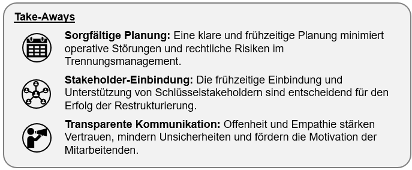
Successful restructuring requires precise and strategic preparation. Particularly in the case of extensive downsizing measures, it is crucial to organize the entire process systematically and at an early stage. Careful planning lays the foundation for a smooth and ethical process, while minimizing operational disruptions, legal risks and potential follow-up costs. Important elements are the definition of clear processes, the creation of realistic timetables and the provision of all necessary resources.
Empathetic and transparent communication is just as essential. Openness and clear information create trust, reduce uncertainty and promote acceptance of the measures. A well thought-out communication strategy that takes into account both economic objectives and the emotional needs of those affected minimizes internal tensions and misunderstandings. This type of communication creates the basis for harmonious cooperation - both during and after the restructuring.
Targeted support measures for the employees concerned are another key component of the preparation. These can include practical assistance such as outplacement services, professional development opportunities or support with reorientation. In addition, emotional support services such as psychological counseling or coaching are essential to make the transition easier for employees. These measures not only show appreciation and social responsibility, but also help to reduce uncertainties and frustrations that could burden the restructuring process.
Through careful planning, clear communication and targeted support, companies can successfully manage restructuring and at the same time lay the foundations for a stable and motivated organization.
The three phases of successful separation management
Effective separation management is based on structured implementation in three central phases: Planning, implementation and stabilization. Each phase has its own specific requirements and makes a decisive contribution to the overall success of the restructuring.
Preparation and planning
Successful restructuring begins with precise preparation. Early and systematic planning is essential in order to minimize operational disruptions, legal risks and follow-up costs, especially in the case of extensive staff reduction measures. This includes clear processes, realistic schedules and the provision of the necessary resources.
Support measures for affected employees, such as outplacement services or psychological counseling, are an important component to facilitate the transition and show appreciation. Transparent communication is also crucial in order to create trust, reduce uncertainty and promote acceptance of the measures.
Implementation and terminations
The implementation phase requires sensitivity and professionalism. Terminations must be communicated transparently, respectfully and sensitively in order to reduce emotional stress and maintain the trust of the remaining employees.
Well-coordinated processes and clear procedures are essential to minimize uncertainties and tensions. The aim is to minimize the impact on everyone involved and to facilitate the transition to the next phase.
Stabilization and reorientation
After implementation, the focus is on stabilizing the organization and supporting the remaining employees. The aim is to restore motivation, trust and productivity. Measures such as team strengthening, conflict resolution and the integration of new structures promote resilience and commitment.
Successful stabilization enables the organization to emerge stronger from the restructuring and look to the future with optimism.
Key stakeholder groups: Challenges and their role in the restructuring process
Successful restructuring requires the early involvement and targeted support of all affected stakeholders. There are three key stakeholder groups in particular: managers and HR managers, employees who have been made redundant and the remaining employees ("survivors").
Managers and HR managers
Dismissal interviews are one of the key tasks of a manager and represent a considerable challenge for both management and the HR department. Such measures are emotionally stressful for everyone involved, and the complexity and dynamics of these processes are often underestimated. This makes thorough preparation, strategic planning and targeted communication all the more important.
In these situations, it is essential to deal with the affected employees in a professional yet empathetic manner. This requires comprehensive preparation on the part of managers, who not only have to conduct the termination talks, but also safeguard ongoing business operations and look after the remaining employees. Well thought-out and transparent communication both internally and externally as well as professional and empathetic management behavior are of crucial importance here in order to cushion the impact of the separation process as much as possible and strengthen team cohesion.
Terminated employees
Employees affected by a dismissal face considerable emotional challenges. They often experience a variety of intense feelings such as anger, frustration, sadness and fear of the future. This emotional strain can also be accompanied by a loss of self-esteem and identity crises. Social isolation and financial insecurity are also additional stress factors that need to be overcome. In order to make the transition to a successful professional reorientation easier for these employees, targeted support is required that offers both emotional stabilization and practical assistance.
Remaining employees ("survivors")
Survivors play a crucial role in the future success of a company, especially in times of crisis. At the same time, however, they are often confronted with anxiety, uncertainty, increased stress and feelings of guilt towards colleagues who have been made redundant. These emotional burdens can lead to internal tensions, which in the worst case can result in incapacity to work or burnout.
Companies need to take countermeasures at an early stage: transparent communication about the restructuring, recognition of the additional burdens and active involvement of employees are of key importance. Managers should make visible adjustments in the short term and respond empathetically to the changed framework conditions in order to strengthen the trust, motivation and resilience of the workforce.
Conclusion: With clarity and empathy to sustainable success
Successful restructuring requires far more than mere efficiency: it calls for a balance between strategic foresight and human sensitivity. Companies that plan early, communicate transparently and incorporate the needs of all stakeholder groups not only create the basis for a smooth transformation, but also for long-term stability.
Targeted support for affected employees, empathetic leadership and the active involvement of the remaining workforce can help to overcome operational challenges and reduce emotional tensions. This enables the organization to emerge stronger from the change and create a sustainable basis for future success.
Restructuring is complex, but with a well thought-out strategy and a human approach, it can become a driver for positive change.
Take Home Message

 Deutsch
  English
  Français
  Italiano